

Dharma, Artha & You
A Guilt-free Practical Guide to Career, Wealth & Purpose
रसो वै सः। रसꣳ ह्येवायं लब्ध्वानन्दी भवति
Raso vai saḥ | rasaṁ hyevāyaṁ labdhvā ānandī bhavati
“He is rasa: essence, delight. Having obtained this essence, one truly becomes joyful.”
Taittirīya Upaniṣad 2.7
What This Book Is About
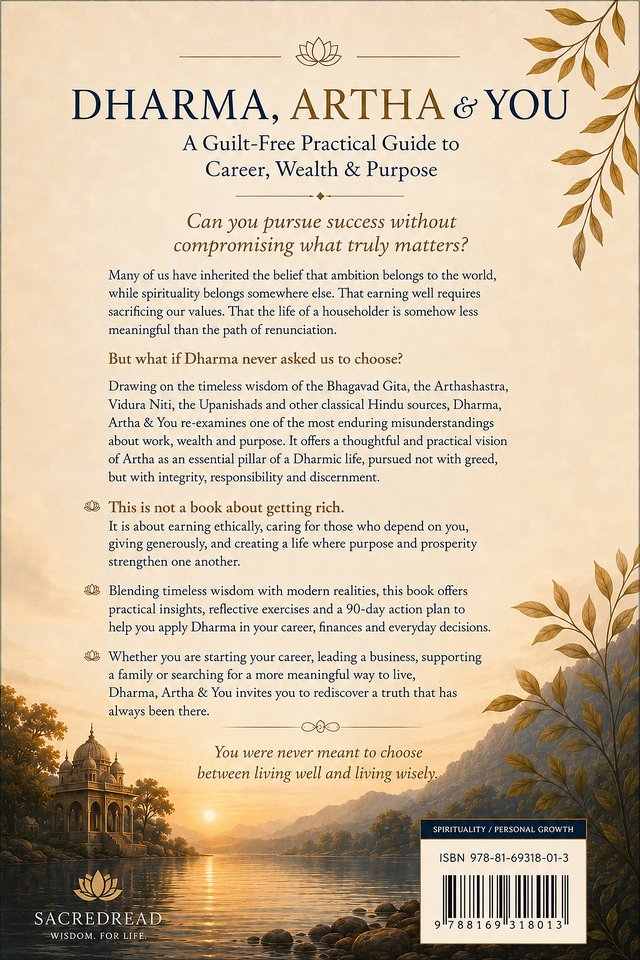
Can you pursue success without compromising what truly matters?
Many of us have inherited the belief that ambition belongs to the world, while spirituality belongs somewhere else. That earning well requires sacrificing our values. That the life of a householder is somehow less meaningful than the path of renunciation.
But what if Dharma never asked us to choose?
Drawing on the timeless wisdom of the Bhagavad Gita, the Arthashastra, Vidura Niti, the Upanishads and other classical Hindu sources, Dharma, Artha & You re-examines one of the most enduring misunderstandings about work, wealth and purpose. It offers a thoughtful and practical vision of Artha as an essential pillar of a Dharmic life, pursued not with greed, but with integrity, responsibility and discernment.
This is not a book about getting rich. It is about earning ethically, caring for those who depend on you, giving generously, and creating a life where purpose and prosperity strengthen one another.
Blending timeless wisdom with modern realities, this book offers practical insights, reflective exercises and a 90-day action plan to help you apply Dharma in your career, finances and everyday decisions.
Whether you are starting your career, leading a business, supporting a family or searching for a more meaningful way to live, Dharma, Artha & You invites you to rediscover a truth that has always been there.
You were never meant to choose between living well and living wisely.
Inside the Book
- Introduction4
- The Guilt Is Not Dharmic9
- Artha Is a Sacred Duty21
- Finding Your Swadharma33
- Working in an Adharmic World42
- Healing Your Money Story53
- Daana Done Right63
- Your 90-Day Dharmic Plan73
- The Householder’s Vow84
- Appendix92
What Readers Are Saying
“A book to be read slowly, then returned to for years.”
Read a Free Sample
The Contents, Preface, Introduction, and Your 90-Day Dharmic Plan are free to read in full below, exactly as written. The remaining chapters are reserved for the VIP Library.
Contents
- Introduction4
- The Guilt Is Not Dharmic9
- Artha Is a Sacred Duty21
- Finding Your Swadharma33
- Working in an Adharmic World42
- Healing Your Money Story53
- Daana Done Right63
- Your 90-Day Dharmic Plan73
- The Householder’s Vow84
- Appendix92
Preface
On Honesty, Inheritance, and Why This Book Was Written
This book began with a conversation I kept having.
Not with scholars or pandits though those conversations happened too. With professionals. With people who were building careers, running businesses, raising children, managing money and who carried, quietly and persistently, a sense that all of this was somehow spiritually suspect.
They were Sanatani. They knew the tradition. They had grown up with the Gita on the shelf and the mandir on the corner and the family wisdom that said: don’t be too attached to the fruits of your labour. And somewhere in the transmission of all of that, the message had arrived slightly garbled.
It sounded like: don’t want too much. Don’t show your success. Ambition is ego. Money is Maya. The truly spiritual person needs very little.
None of those sentences are in any scripture. But they felt like scripture because they came from people who were loved, spoken in contexts that felt sacred, repeated across generations with the weight of settled truth.
“None of those sentences are in any scripture. But they felt like scripture.”
This book is an attempt to trace that garbling back to its source. To ask: what does the tradition actually say? Not what was passed down through families under economic pressure, not what colonial interpretation decided was the ‘real’ Hinduism, not what reform movements elevated because it made the tradition more legible to outsiders but what the texts themselves, read honestly and in context, actually teach.
The answer is more generous than most of us were told.
The Grihastha the householder, the person in the middle of the world with responsibilities and ambitions and a family and a career is not a spiritually inferior being waiting to graduate to renunciation. The tradition places the Grihastha at the centre. The Arthashastra is a real text, taken seriously, producing one of the most sophisticated economic philosophies in the ancient world. Artha is a Purushartha, one of the four legitimate aims of human life, not a concession to weakness.
“You were never asked to choose between Dharma and prosperity. You were asked to hold both, together, in the tension that the tradition called wisdom.”
A note on how this book handles uncertainty: every scriptural reference included here has been cited with care. Where specific verses are reproduced with Sanskrit, they are verses the author is genuinely confident about. Where uncertainty exists in the text, the text says so. Where a concept is drawn from a text but no specific verse is cited, it is because a reliable verse could not be confirmed and an honest omission is always preferable to a confident fabrication.
Readers who are scholars or pandits will find places to add nuance. That is welcome. This book is a beginning, not a final word. It is an invitation to go deeper into the primary sources which are listed in the Appendix and to form your own relationship with what they teach.
The tradition belongs to you. Not as heritage to be proud of from a distance, but as a living resource for the actual decisions of your actual life.
This book is about how to use it.
Introduction
You Were Never Meant to Choose
There is a particular kind of exhaustion that comes not from overwork but from internal conflict.
You know the kind. It’s the tiredness of a person who is simultaneously trying to succeed and trying not to care about success. Who builds a career and then feels vaguely guilty about building it. Who earns money and then feels strange about having it. Who wants more for their family, for their future, for the causes they care about and then wonders whether wanting more is itself the problem.
If you are Hindu, and you are ambitious, and you are somewhere between 28 and 45, there is a reasonable chance this is your experience. Not in a dramatic, obvious way. Just as a low-grade background hum. A quiet dissonance between the life you are building and the spiritual self-image you were handed.
This book exists because that dissonance has a source and the source is not your tradition.
What This Book Is
This is a practical philosophical guide for the Grihastha who wants to build a career and a financial life that is genuinely Dharmic. Not performatively spiritual. Not guiltily materialistic. Actually, honestly Dharmic, in the way the tradition meant before centuries of distortion accumulated on top of it.
It covers five interconnected things:
- Where the guilt about wealth and ambition actually came from and why it isn’t in any scripture you’ve actually read.
- What your tradition genuinely says about wealth Artha as one of the four sacred aims of human life.
- How to identify and pursue your Swadharma your own right action practically, not mystically.
- How to operate with integrity inside imperfect, sometimes adharmic work environments.
- How to build a Dharmic relationship with money, and a giving practice that actually feels like Dharma.
And it closes with a 90-day plan because insight that stays in the head produces nothing. The tradition itself understood this. Krishna didn’t give Arjuna a philosophy and then say “take your time with it.” He gave him the understanding and then said: act.
What This Book Is Not
It is not a prosperity gospel, a repackaging of “think positive and wealth will follow” in Sanskrit vocabulary.
It is not anti-renunciation. Sannyasa is a genuine and honourable path. This book is simply not for the person on that path. It is for the person in the middle of the world with responsibilities, with a career, with a family or one forming, with bills and ambitions and ethical decisions to make every week.
It is not Western self-help with Sanskrit words added. The frameworks in this book come from the texts themselves: the Gita, the Arthashastra, the Mahabharata, the Upanishads. They are presented in plain language, but they are not invented. Where the author is uncertain about a specific reference, that uncertainty is stated clearly rather than smoothed over.
Who This Book Is For
You are a Grihastha or becoming one. You are in the phase of life the Vedic tradition designated for full engagement with the world: earning, building, contributing, giving, raising a family, making decisions that matter.
You have, at some point, felt the pull between ambition and guilt. Between wanting more and wondering if wanting more is the problem. Between the Dharmic person you are and the successful professional you are becoming.
This book is for that tension. It will not resolve it by asking you to choose one side. It will resolve it by showing you that the choice was always a false one.
यदा यदा हि धर्मस्य ग्लानिर्भवति भारत।
अभ्युत्थानमधर्मस्य तदात्मानं सृजाम्यहम्॥
Yadā yadā hi dharmasya glānir bhavati bhārata
Abhyutthānam adharmasya tadātmānaṁ sṛijāmy aham
“Whenever there is a decline of Dharma, O Bharata, and a rise of Adharma, I manifest myself.”
Bhagavad Gita 4.7
This verse is usually read in grand civilisational terms. But it applies personally too. When Dharma declines in your own understanding when distortion replaces clarity, the tradition offers a correction. That is what this book is: a correction. A recalibration. A return to what your tradition actually said before fear, history, and misreading accumulated on top of it.
How to Read This Book
Read it in order the first time. Each chapter resolves one internal conflict and creates the next question that sequence is intentional. Then use it as a reference. The 90-day plan in Chapter 7 is designed to be worked, not just read. The twelve Svadhyaya questions in the Appendix are designed to be returned to as often as needed.
The tradition you come from produced the Arthashastra, one of the most sophisticated economic and political philosophy texts in the ancient world. It designated the Grihastha not as a spiritually inferior being but as the central pillar of the entire social and spiritual system.
“You were never meant to apologise for building something. You were always meant to build it well.”
Let’s begin.
CHAPTER ONE
Your 90-Day Dharmic Plan
Career & Money – Turning Insight Into Action
KEY SHLOKA
तस्मादसक्तः सततं कार्यं कर्म समाचर।
असक्तो ह्याचरन्कर्म परमाप्नोति पूरुषः॥
Tasmād asaktaḥ satataṁ kāryaṁ karma samāchara
Asakto hy ācharan karma param āpnoti pūruṣhaḥ
“Therefore, without attachment, always perform the action that is your duty. By performing action without attachment, one attains the Supreme.”
Bhagavad Gita 3.19
This verse sits at the heart of the 90-day plan. Not one action done perfectly. Consistent, unattached, duty-oriented action, week after week, without waiting for perfect conditions or guaranteed outcomes. That is the practice. That is the path.
The Gita itself doesn’t just give Arjuna a worldview, it gives him something to do. Pick up the bow. Act. Now. So that’s what this chapter is. Not more philosophy. Not more reframes. A specific, week-by-week plan for the next ninety days that takes everything in this book and turns it into actual decisions and actions in your actual life.
Ninety days because that’s long enough to create real change and short enough to stay committed. Three months. Twelve weeks. Roughly one focused shift per week. You don’t have to do this perfectly. You don’t have to do all of it. But you have to start and you have to start today, not after you’ve finished re-reading the chapters, not after you’ve built the perfect spreadsheet, not on the first of next month. Today.
Before You Begin – The Svadhyaya Baseline
Svadhyaya means self-study. It is one of the Niyamas in yogic philosophy, the practice of honest, ongoing self-examination. Before week one starts, spend one hour doing this. Not a week. One hour. Write physically, write honest answers to these four questions:
The Svadhyaya Baseline (one hour)
1. What is my current relationship with earning? Am I underearning relative to my capability? Overworking without a sense of direction? Earning well but feeling empty about it? Be specific.
2. What is my current relationship with money? Anxious? Avoidant? Reckless? Hoarding? Which of the three distortions from Chapter 5 is most active right now?
3. What is my current relationship with my work? Am I living Swadharma or Paradharma? Am I operating with integrity, or making compromises I’ve stopped noticing?
4. What would I want to be able to say about these three things in ninety days? Not a fantasy. A realistic, specific shift, one sentence each.
This is your baseline. It tells you where you actually are, not where you wish you were or where you’re afraid to admit you are. Keep it somewhere you’ll see it at the end of the ninety days.
Month 1 – Clarity
The job of Month 1 is not to change anything. It is to see clearly.
Most people skip this and jump straight to action. They set new financial targets before they’ve understood their current money story. They plan career pivots before they’ve identified their actual Swadharma. They start giving more before they’ve examined why their current giving feels hollow. Don’t skip this month. Clarity is not passive. It is the hardest and most important work.
Week 1 – The Guilt Audit
Revisit Chapter 1. Then write down every belief about money or ambition you absorbed before the age of eighteen. Next to each one, mark it W (wisdom – genuinely true and useful) or F (fear – a survival story masquerading as a value). For every F belief, write one sentence that replaces it with a Purushartha-grounded alternative. This is not about rejecting your upbringing. It is about choosing consciously what you carry forward.
One action this week: Have one honest conversation with yourself or someone you trust about which F belief has cost you the most. Name it clearly. That naming is the beginning of its losing power over you.
Week 2 – The Swadharma Map
Return to the four-column exercise from Chapter 3: Natural Strengths; Where I Create Real Value; What the World Around Me Needs; What I’d Commit to Without Guaranteed Outcome. If you did it while reading, do it again now. The first attempt is usually polished. The second attempt, done with more honesty and a little distance, is usually more accurate.
One action this week: Show your completed map to one person who knows you well not to get validation, but to ask: “Does this match how you see me?” Other people’s observations about your nature are data.
Week 3 – The Career Alignment Check
Now that you have a clearer Swadharma map, score your current work situation against it. Does my current role use my natural strengths daily or occasionally? Does my work create genuine value, or mostly administrative output? Am I in the right functional type, builder, teacher, leader, craftsman or have I drifted into a role that doesn’t fit my Swabhava? If I had to give my current career path a percentage score for Swadharma alignment, what would it be? You are not making any decisions this week. You are just generating an honest score.
One action this week: Identify the single biggest gap between where you are and where your Swadharma map points. One gap. The most important one.
Week 4 – The Adharma Inventory
Recall Chapter 4’s Four-Level Adharma Test. Go through your current work life and identify: one Level 1 situation you’ve been treating as a crisis; one Level 2 situation you’ve been staying silent about when you should have spoken once; one Level 3 line you’ve been getting dangerously close to crossing; and whether you are honestly in a Level 4 situation that requires an exit plan. This inventory is not to produce guilt. It is to produce clarity about where you actually are.
One action this week: Handle the Level 2 situation. Raise it once, clearly, to the right person. Then let it go.
Month 2 – Restructure
The job of Month 2 is to change the structures, not your mindset, not your intentions, your actual structures.
Mindset work without structural change is just mood management. You need to change what is actually happening in your money and your work, not just how you feel about it.
Week 5 – The Income Audit
This is about Artha as duty, from Chapter 2. Answer with real numbers: What is your current income? What would it be if you charged or earned in genuine proportion to your capability and output? What is the gap? What is the single most leveraged thing you could do to begin closing it? The most common answers: negotiate an overdue salary increase you’ve been avoiding; raise your client rates to a number that reflects your actual value; have a scope conversation you’ve been putting off; start the side income stream you’ve been thinking about for two years.
One action this week: Take one concrete step toward closing the gap. One email, one conversation, one number written down and committed to. If the gap is a salary negotiation you have been deferring, the action this week is to book the meeting not have it, book it. If it is a client rate you have not raised in two years, the action is to write the new number on paper and set a date by which you will send it. The meeting or the email can happen in Week 9. This week, the commitment becomes real.
Week 6 – The Four-Bucket Setup
From Chapter 5, set up your actual allocation. Not a complex budgeting system. Four clear buckets with a percentage assigned to each: Household (your primary obligations); Growth (savings and investment); Self (deliberate spending on your own renewal); Daana (intentional giving, planned first, not given from what’s left). The specific percentages are yours to determine. What matters is that all four exist, all four are deliberate, and Daana is planned rather than reactive.
One action this week: Open a separate account or at minimum a separate row in a spreadsheet for Daana. Put something in it this week, however small. The act of creating the container matters before the amount does.
Week 7 – Apply the Four-Level Test to Your Live Situation
Return to the Adharma inventory from Week 4. Pick the most active ethical tension in your current work life the one you’ve been managing around rather than addressing. Run it through the Four-Level Test with complete honesty: Is this actually adharmic or just uncomfortable (Level 1)? Does it require you to speak up (Level 2)? Does it require you to refuse a specific action (Level 3)? Does it require an exit plan (Level 4)? Then do what the level calls for. Not what is easiest.
One action this week: One Vidura move. Speak once, refuse once, or begin planning your exit. Whatever is honest.
Week 8 – The Daana Intention
From Chapter 6, map your four circles. Family: is there an obligation you have been deferring? Community: Is there one person or small business in your immediate sphere you could support more fairly right now? Civilisation: identify one organisation doing genuine Dharmic cultural work, run it through the evaluation checklist before committing. Creation: identify one ecological cause or choice that aligns with the Bhumi Mata principle.
One action this week: Make one purposeful, Sattvic Daana. Not a guilt donation. One deliberate transfer of resources however modest to the right person, at the right time, with genuine intention.
Month 3 – Momentum
The job of Month 3 is to make this permanent to turn decisions into habits and intentions into identity.
Week 9 – Renegotiate One Thing
Pick one area where you have been accepting less than your work is worth, a rate, a scope, a boundary, a relationship dynamic and renegotiate it. This week is about evidence. You have spent eight weeks getting clarity and restructuring. Now you act on it in one concrete, external negotiation. Prepare properly: know your number before you enter the conversation; know what you’ll say if they say no; know that the conversation itself regardless of outcome is a Dharmic act of valuing what you bring.
One action this week: Have the conversation. This week. Not when you feel ready, because you will not feel ready. The conversation itself is the practice.
Week 10 – Review Your Daana Allocation
Look at what actually went into your Daana bucket over the last month. Did I give what I planned? If not, what got in the way? Was the giving Sattvic, freely given, rightly directed, without expectation? Is there one giving relationship I want to deepen or one I want to redirect?
One action this week: Make one giving decision based on discernment, not social pressure. Say yes to something you genuinely believe in. Say no clearly and without guilt to a request that doesn’t meet the standard. If a temple committee, a family member, or a cause you have been funding out of obligation asks again this month, use this exact construction: “I’ve been giving that some thought and I want to be honest, it’s not where my giving is focused right now. I hope the work goes well.” No further explanation is required. The sentence is complete.
Week 11 – Write Your Swadharma Statement
You now have ten weeks of self-examination behind you. It is time to articulate what you found. Write a single paragraph no longer that describes your natural strengths and primary functional type; the kind of value you are most built to create; and the direction your career and wealth-building should move over the next three years. This is not a mission statement. It is not for anyone else’s eyes. Keep it short. Keep it honest. Keep it somewhere you will read it once a month.
One action this week: Write the paragraph. One paragraph. Then read it aloud once.
Week 12 – Set Your Sankalpa
Sankalpa is a formal intention, a vow made not to the world but to yourself, rooted in your deepest understanding of what you are here to do. This is your final action of the ninety days. Write your Sankalpa for the next year, covering: one commitment about how you will earn with what integrity, toward what level, for what purpose; one about how you will manage and allocate what you earn; one about how you will give to whom, with what intention; one about the kind of professional you will be in adharmic moments.
One action this week: Read it aloud. Then put it somewhere physical, not just digital. Paper on a wall. A journal you open daily. Somewhere it will look at you.
The Daily Anchor – Five Minutes Every Morning
This is the practice that holds everything else together. Before the working day begins, before the phone, before email, before the noise, three questions:
The Daily Anchor – three questions, every morning
1. What is my primary Dharmic obligation today? Not your task list. The most important thing you could do today that serves something beyond just you.
2. Where might I be pulled toward Paradharma today and what is my response? Anticipate the moment of compromise before it arrives. Decide in advance.
3. Is there one action today that creates value for someone beyond myself? Could be large. Could be tiny. But intentional.
Five minutes. Ninety seconds per question. Every day. This is your Svadhyaya practice made daily, not a ritual that requires special conditions, just three questions that keep you oriented to what actually matters.
Ninety Days From Now
Here’s what is possible. Not guaranteed. Possible, if you do the work.
- You will have named and examined the inherited beliefs that were running your financial life on autopilot
- You will have a clearer sense of your Swadharma than you have ever had and a direction, even if imperfect
- You will have had at least one honest conversation about integrity at work that you had been avoiding
- You will have a real, functioning Daana practice however small, that feels like choice rather than obligation
- You will have renegotiated something, a rate, a boundary, a relationship that was costing you more than money
That is not a small thing. That is a life that has shifted in its orientation. The goal was never perfection. The goal was never to become a different person.
“The goal was always to become more fully yourself living your Artha in service of your Dharma, with the clarity and courage your tradition has been offering you all along.”
It was always there. You just needed the map.
Next – Closing: The Householder’s Vow
CLOSING
Members Only
Continue Reading in the VIP Library
The complete book is reserved for approved members of the Sacred Read VIP Library. Request an invitation below; every request is reviewed personally by Maitreyi.
Have questions first? Get in touch.
Related Books
Coming Soon
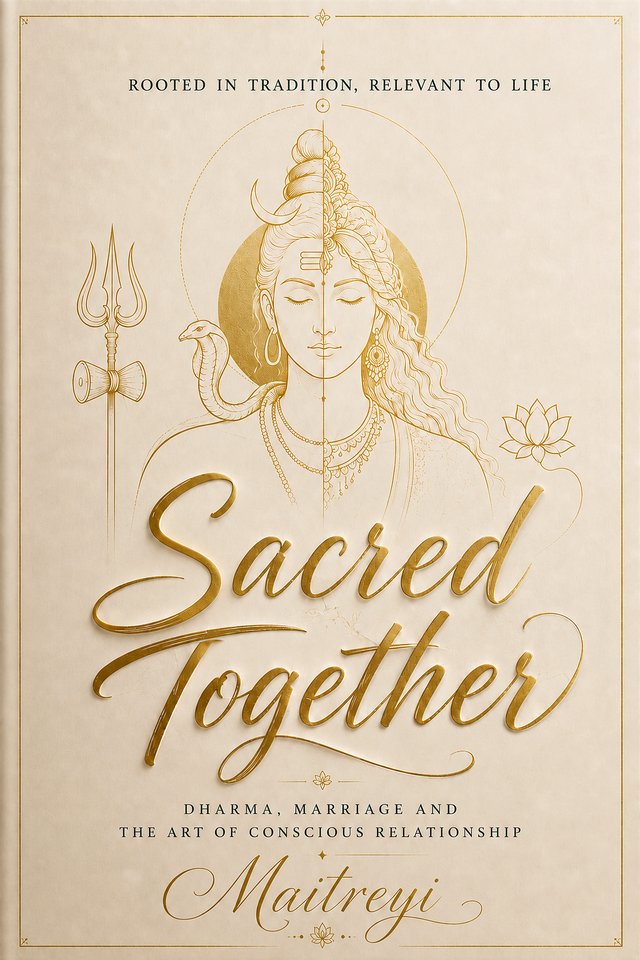
Sacred Together
Dharma Marriage and the Art of Conscious Relationship
More titles will appear here as the library grows. View the full Library →